
Ir al contenido de la página

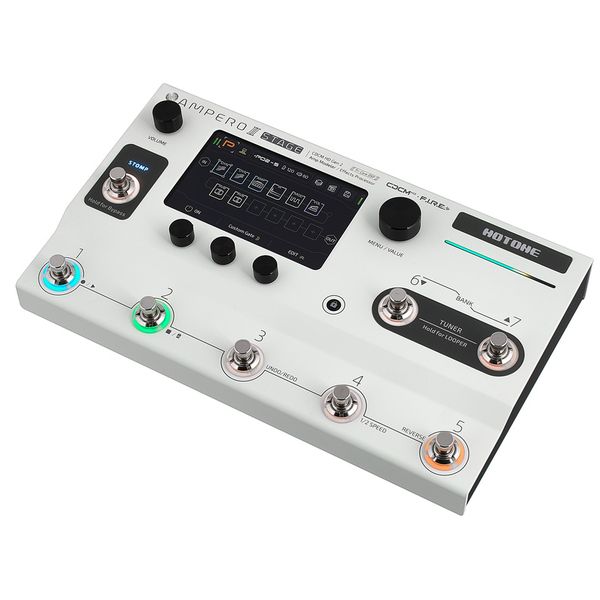
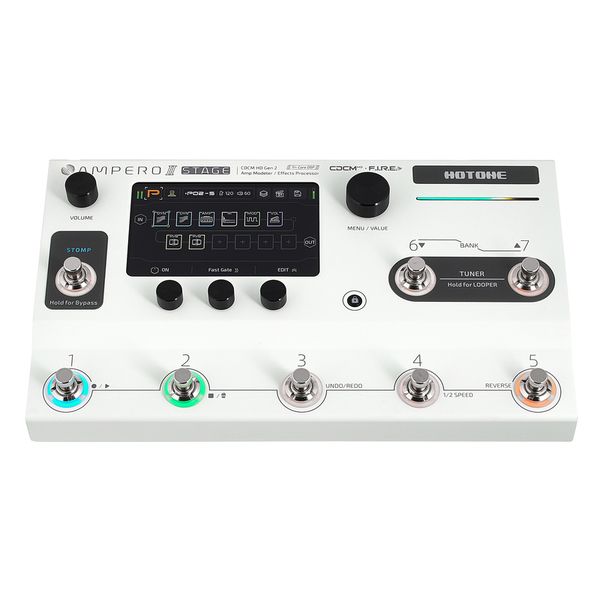
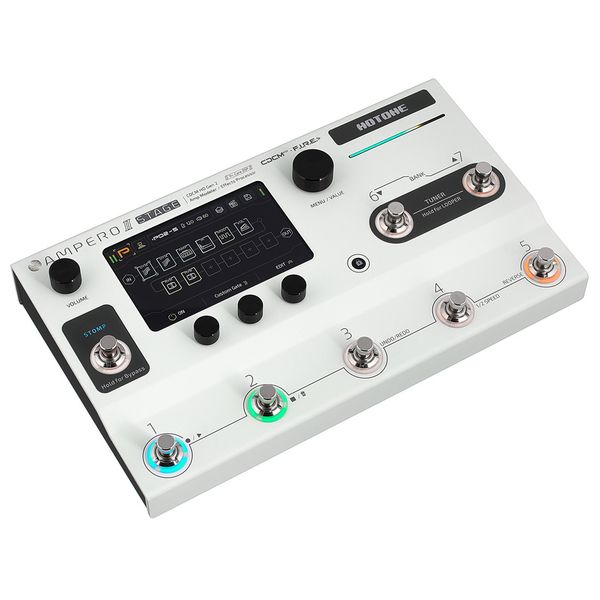
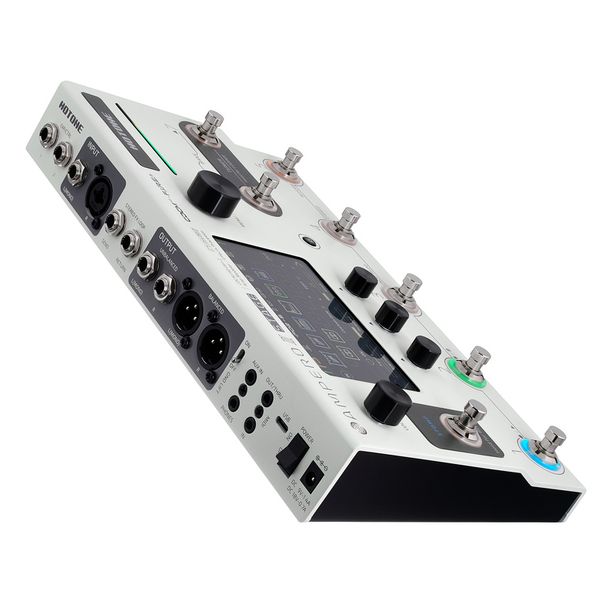
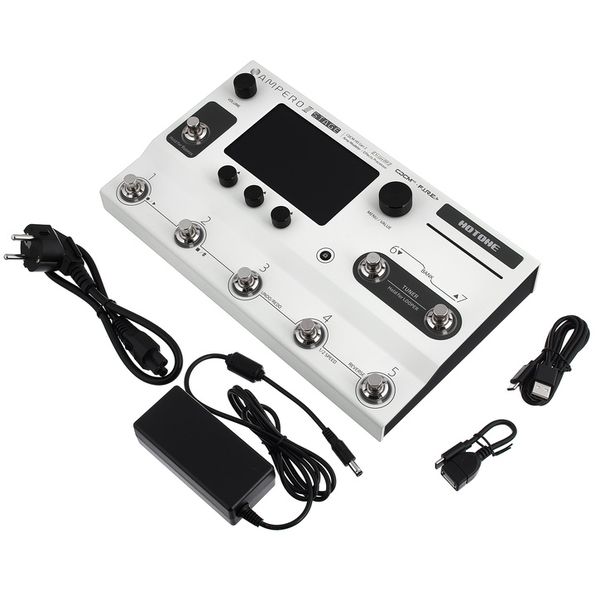
Pedal multiefectos para guitarra eléctrica

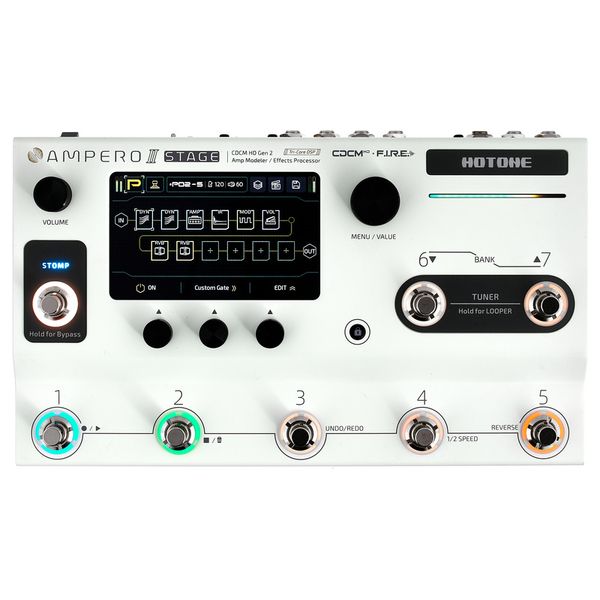
  • Procesador de efectos Modeling Trial-DSP
  • Hasta 12 efectos simultáneamente, más de 460 efectos, más de 90 modelos de amplificadores, 68 modelos de pantallas, más de 100 modelos de pedales, modelado de posición y tipo de micrófono
  • Soporta respuestas de impulso adicionales de terceros fabricantes (IR Loader) por medio del editor Hotone
  • Procesamiento de señal de 24 bits con 127 dB S/N Ratio
  • Looper integrado con tiempo de grabación en estéreo de 60 segundos
  • Módulo de batería integrado
  • Simulación de guitarra acústica
  • Conexión USB para la edición de IRs/efectos o para el empleo del Ampero como interfaz de audio USB
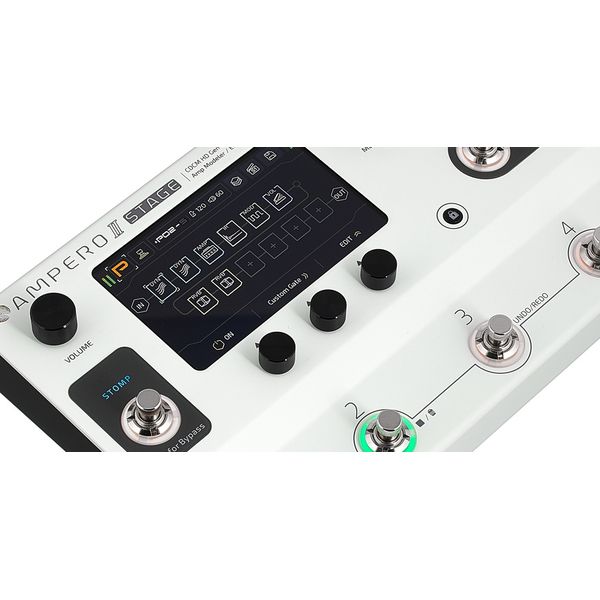
  • Reguladores: Volume, Menu/Value, 3 reguladores de giro para el manejo de la pantalla táctil
  • LED: Anillo de luz para todos los pedales
  • Barra de estado
  • Pantalla táctil de 5" con resolución de 800 x 480 pixels
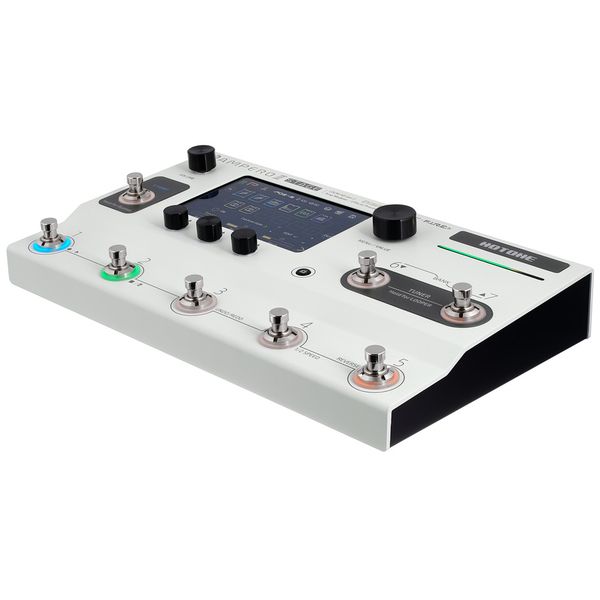
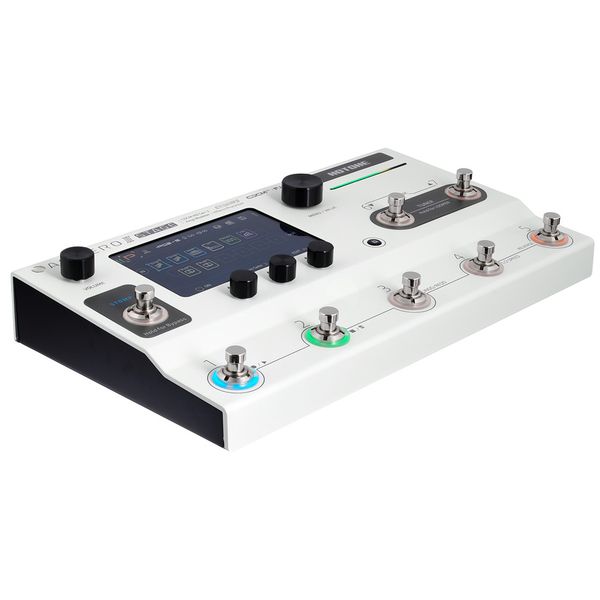
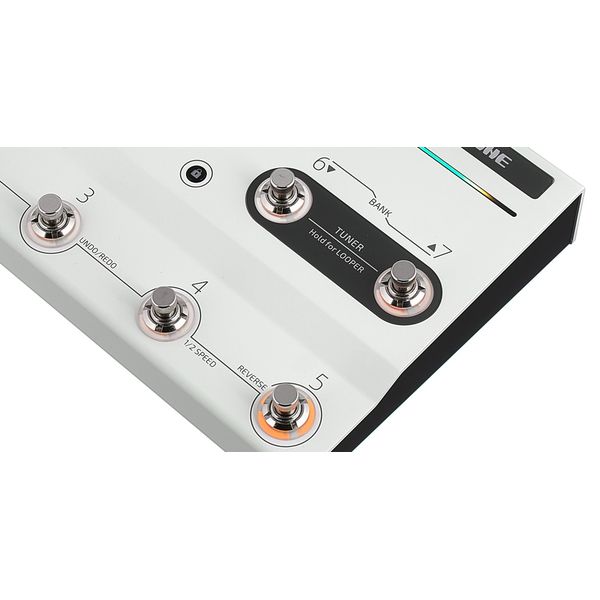
  • Pedalera: 8 pulsadores
  • Interruptor de masa
  • Consumo: 500 mA
  • Alimentación por transformador externo de 9/18V DC (no es posible el funcionamiento con pilas)
  • Dimensiones (An x P x Al): 301 x 180 x 58 mm
  • Peso: 1,9 kg
  • Incluye fuente de alimentación

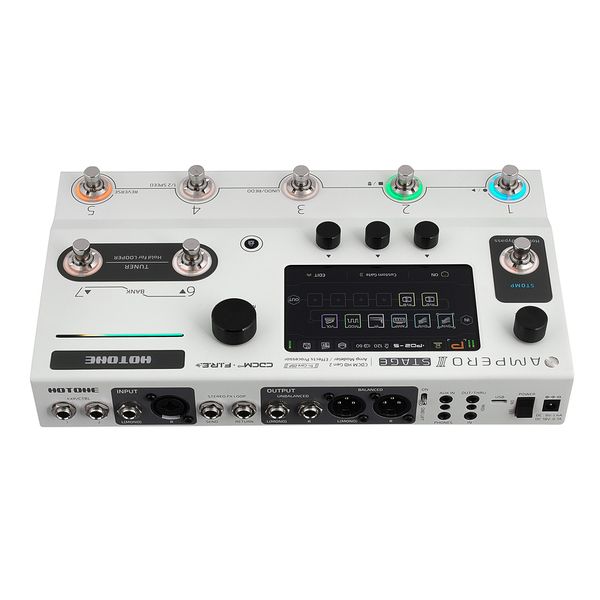
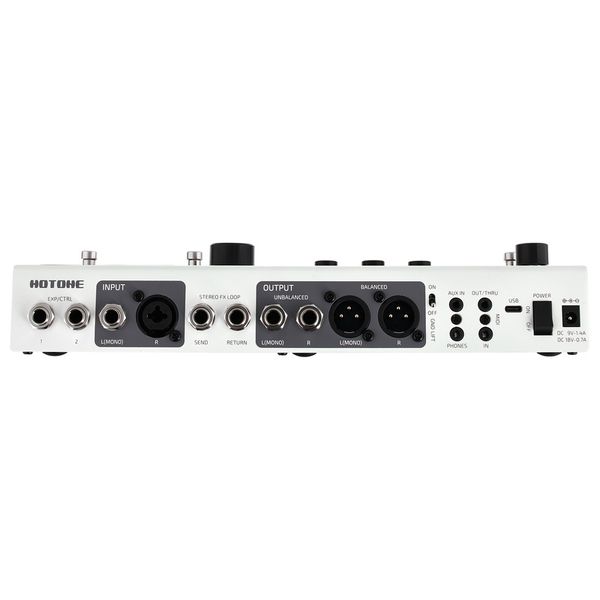
Conexiones:

  • Entrada: Jack de 6,3 mm
  • 2 entradas para efectos externos: Jack de 6,3 mm
  • 1 conector combinado XLR/TRS con preamplificador de micrófono integrado, alimentación fantasma y 5 modos de entrada
  • Conexión estéreo para retorno de bucle de efectos: 2x Jack de 6,3 mm
  • 2 salidas no balanceadas: Jack de 6,3 mm
  • 2 salidas XLR
  • Entrada auxiliar: Minijack de 3,5 mm
  • Conexión de auriculares: Minijack estéreo de 3,5 mm
  • Entrada MIDI: Minijack de 3,5 mm
  • Salida MIDI: Minijack de 3,5 mm
  • Puerto USB-C
  • Conexión para transformador de red: Conector coaxial de 5,5 x 2,1 mm, con polo negativo en el interior
  • Disponible desde Diciembre 2023
  • número de artículo 579391
  • Precio por 1 Unidad(es)
  • Método de construcción´ Pedalera
  • Amp Modeling
  • Caja de ritmos
  • Incluye afinador
  • Pedal de expresión No
  • USB-anslutning
  • Conexión para auriculares
  • Interfaz MIDI
  • Line Out
  • Alimentación a pilas No
  • Fuente de alimentación incluida
  • Diseño Pedalera
  • Efectos
  • Salida directa
  • Puerto MIDI
  • Conectores para pedales o conmutadores
  • Aux-in
  • Afinador integrado
599 €
Todos los precios incluyen IVA
En stock
1

42 Valoraciones de los clientes

4.7 / 5

Uso

Características

Sonido

Fabricación

32 Reseñas

M
Cumple perfectamente toto lo que puedes esperar.
Maleve 30.06.2024
Fácil de manejo, buen sonido, robusta. Relación calidad precio fenomenal!!!
Uso
Características
Sonido
Fabricación
3
0
Reportar evaluación

Reportar evaluación

google translate gb
Lamentablemente hubo un error. Por favor, inténtelo de nuevo más tarde.
m
HoTone Stage Wow !
mtjg 16.01.2024
Brilliant product. I’ve been looking out for it since launched in October. It doesn’t disappoint. Build quality, user interface, and even better iOS control. No Android app yet but that may follow on
Uso
Características
Sonido
Fabricación
14
0
Reportar evaluación

Reportar evaluación

google translate gb
Lamentablemente hubo un error. Por favor, inténtelo de nuevo más tarde.
Ms
Amazing modeler & clarity
Modelers, stompbox 03.11.2024
This product fully met my expectations, and I have no regrets about purchasing it. It is suitable for any type of music and will definitely meet your needs. As a metal musician, I found many amp and preamp modelers, as well as high-quality distorted amps, in the Ampero Stage. The best feature is the microphone adjustment when selecting the cabinet option, which makes a significant difference. I am pleased with the sound quality and clarity of this device.
Uso
Características
Sonido
Fabricación
10
0
Reportar evaluación

Reportar evaluación

google translate gb
Lamentablemente hubo un error. Por favor, inténtelo de nuevo más tarde.
Af
Great Potential, Not Quite There Yet
Alex from Brussels 19.01.2026
19.01.26 – Initial Feedback

Backstory
My journey into amp modelers began recently, driven by a desire for greater tonal versatility—especially for my American Stratocaster with single coils. My home setup consists of an Engl Fireball 25 (KT77) paired with a Victory 2x12 closed-back cabinet, which is an excellent match for my main use case: metal. My pedalboard is minimal, limited to a reverb.
However, a high-gain amp like the Fireball is not well suited for SRV-style Strat tones without adding multiple pedals and effects. I play exclusively at home, at moderate volume, through a real cabinet. Headphones or studio monitors were never an option—the feel of a real amp and cab is irreplaceable to me. At the same time, I wasn’t interested in buying additional amps or building a large pedalboard just to cover more ground tonally.
This led to a simple idea: using an amp modeler purely as a preamp into the effects loop return of my Fireball, bypassing its preamp and using it only as a power amp. While power amp coloration is often debated, for home use this felt largely irrelevant.
After weeks of research, I tried the Neural DSP Nano Cortex, purchased locally—but ultimately returned it. Despite overwhelming hype and positive reviews, the unit was a major disappointment. Before buying, I explained my exact use case to Neural support, who confirmed the Nano Cortex would be suitable, advising me to disable cab/IR simulation and use preamp captures (which I did, including global IR/CAB bypass).
Despite extensive tweaking, I couldn’t achieve a satisfactory tone. The unit was extremely noisy, and the captures suffered from resonant artifacts, excessive low-end boom, and general noise issues. Routing options were very limited, there was no effects loop, editing was restricted to a mobile app, and build quality was questionable—one knob came off within a week.
With high expectations unmet, the Nano Cortex went back. My next options narrowed down to the Line 6 HX Stomp and the Hotone Ampero II Stage.

Competition
The current modeler market is very competitive. While the HX Stomp is well supported and popular, it was released nearly a decade ago. Its small, old-school display and limited DSP ultimately put me off. In contrast, the Hotone Ampero II Stage appeared to hit a sweet spot, offering a strong feature set at a competitive price.
Some compare it to the Quad Cortex, but that comparison is unfair given the difference in price and scope. More realistic competitors are the Neural DSP Nano Cortex, Line 6 HX Stomp, Boss GX-100, IK Multimedia ToneX Pedal, and possibly the Kemper Profiler.
What made the Ampero II Stage stand out was its ability to split preamp and power amp sections, a usable touchscreen, flexible routing including four-cable method support, recently added capture support (for using shared captures), and a solid selection of amp/preamp models and effects. Below is my experience broken down by category. I’ll continue updating this review while deciding whether to keep or return the unit.

Build Quality & Aesthetics
The unit feels sturdy, built from thick metal with solid footswitches. All connections feel reliable with no wobble.
The white finish won’t appeal to everyone, but it doesn’t look cheap and gives a professional impression. The layout is well thought out, though additional color options would have been welcome.

Sound Quality
After my Nano Cortex experience, expectations were low—but the Ampero II Stage surprised me. Several factory presets are immediately usable for both high-gain and clean tones. Most importantly, my intended use case—running into the effects return of the Engl Fireball—worked very well.
Even running full amp models into the power amp sounded better than expected, but using preamp-only models improved things further. The dynamic response is close to a real amplifier, and for the naked ear, differences are negligible in a home setting.

Connectivity & Routing
Routing and connectivity are excellent. Four-cable method support, flexible signal chains, and amp blending options make this one of the unit’s strongest areas.

DSP
DSP is the main technical limitation. Using captures can consume up to 70% of available DSP, leaving room for only a few effects—often making it impossible to add reverb. That said, for typical use cases involving amp models with several pre- and post-effects, DSP is sufficient.
Capture functionality was added later, and the unit was clearly not designed with it in mind. Optimization is needed.

Captures
Access to NAM profiles is a big plus, offering thousands of options. However, Hotone’s native “Tone Catch” library is extremely limited. For example, searching for a JCM800 yields only two captures, compared to hundreds on Cortex Cloud.

User Interface
Both the onboard UI and desktop editor are excellent—intuitive, responsive, and well designed. On-screen chain editing, easy preset management, community downloads, and Bluetooth mobile app support are all very well executed.

Community & Support
This is where the product falls short. The forum shows users actively sharing feedback and asking questions, but responses from Hotone are nonexistent. The community is mostly Chinese-speaking, and official engagement is effectively zero.
Support is, bluntly, absent. Multiple attempts to report issues or provide feedback went unanswered. This stands in sharp contrast to Neural DSP, whose support team is responsive and helpful.

Development Cycle
Development is slow. Longstanding bugs remain unresolved, even as major features like captures are added. Priorities feel misaligned.

Conclusion
Overall, my experience with the Ampero II Stage has been largely positive. It sounds good, works well in a real-amp setup, and offers excellent usability and routing for its price. However, the lack of support and an almost nonexistent community significantly limit its long-term appeal. Software evolution and communication are critical for products like this; without them, even good hardware risks becoming obsolete. The unit is still within the return period, so testing continues, and I’ll share my final thoughts soon.
Uso
Características
Sonido
Fabricación
2
0
Reportar evaluación

Reportar evaluación